

If you run a live event production company, you’ve had the AI conversation at least three times this quarter. Probably with your ops lead. Probably with a vendor. Probably with yourself at 11 PM after a show.
The question is rarely whether to adopt AI anymore. It’s how: how to choose it, how to roll it out, and how to make sure it actually works inside the business you’ve already built.
Here’s the short version. In an industry as operationally complex as live events, AI is only as useful as the system it lives inside. Generic tools give you answers. Native AI gives you operational leverage. And the gap between those two things is going to define which companies scale over the next five years and which ones spend the next five years cleaning up data.
The Short Answer
Should event companies build their own AI, buy a generic tool, or leverage AI that’s native to their operational system?
For the vast majority of event production companies, native AI, meaning AI built directly into the operational system you already run your business in, is the only version that actually pays off. Generic AI tools can’t see your crew, your gear, your rates, your rundowns, or your margins. They can only see what you paste into them. In an industry where a single show touches staffing, inventory, scheduling, payroll, and compliance in the same 24 hours, that’s a dealbreaker.
Why Generic AI Falls Apart in Live Events
Generic AI tools like ChatGPT, Copilot, and standalone AI assistants are impressive in isolation. They write emails. They summarize documents. They can draft a scope of work if you feed them enough context.
But event operations aren’t an isolated task. They’re a live, interconnected system. Consider what a single Friday looks like at a mid-sized production company:
- Three shows loading in across two cities
- A last-minute A1 swap that triggers an overtime threshold
- A subrental that needs to clear insurance before the truck rolls
- A client asking why the invoice is different from the quote
- Payroll running in 48 hours with certifications that need to be verified
A generic AI tool can’t answer a single one of those questions with any real accuracy, because it doesn’t know your crew database, your gear inventory, your union rules, your rate cards, or your margin structure. It’s guessing against whatever you paste into the prompt. And in event production, guessing is expensive.
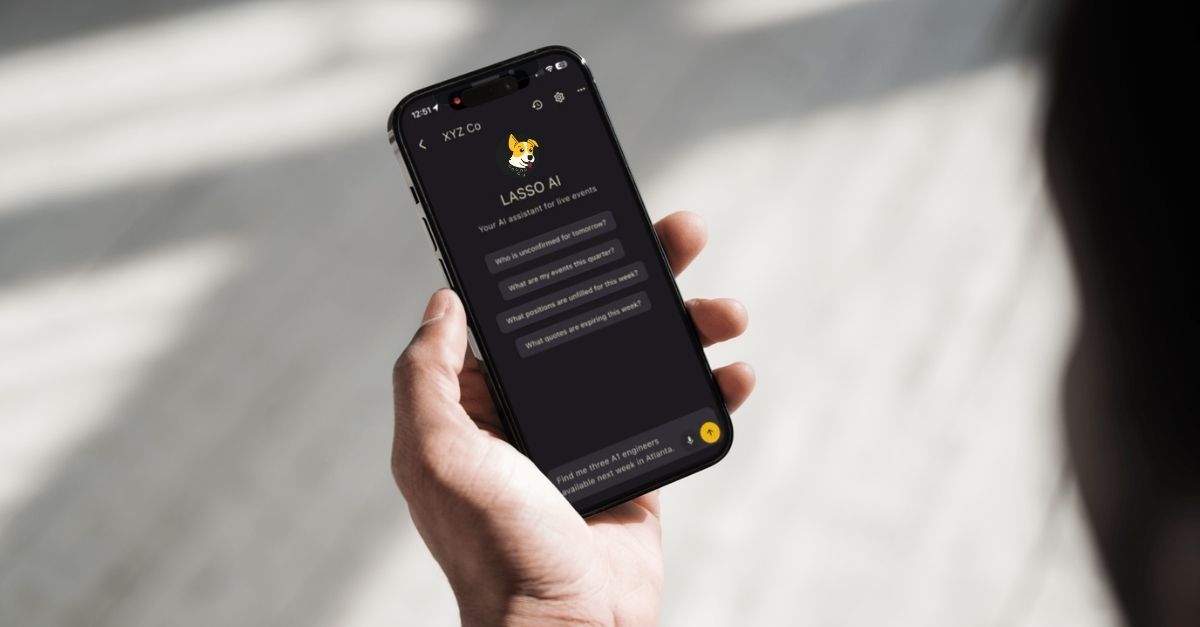
Native AI lives inside the operational system where your quotes, crew, inventory, schedules, and payroll already live. It doesn’t guess. It answers from the actual state of your business.
That’s not a feature difference. That’s a category difference.
The Real Cost of “Good Enough” AI
The hidden cost of AI isn’t the subscription fee. It’s the operational drag of having AI that doesn’t know anything your team knows.
Every time an ops lead copies data out of one system, pastes it into a chatbot, edits the response, and puts it back somewhere else, that’s time. Multiply it across a team, across a quarter, across a peak season. You haven’t automated anything. You’ve added a new step.
And in an industry where margin is built or lost in the operational details, a new step isn’t neutral. It’s a tax.
What “Industry-Native AI” Actually Requires
Not every tool that claims native AI is native. There’s a real bar, and it’s worth knowing what to ask for.
True industry-native AI understands the vocabulary of your business without translation. It knows the difference between a load-in and a strike. It understands that an A1 isn’t a highway. It treats a subrental like a subrental, not a line item. It knows that “crew” in live events is a living, union-aware, certification-dependent thing, not a static list of names.
It’s also connected to the real data: your crew roster, your inventory, your rundowns, your invoices, your payroll. If the AI can’t see all of it, it can’t reason across all of it. Reasoning across the full operation is where the value is.
And it has to have a human in the loop. The event production companies we trust most don’t want AI that acts without oversight. They want AI that surfaces the right thing, flags the risk, and hands the decision back to a human who owns the outcome. That’s not a compromise. That’s the design.
The All-In-One Advantage
The companies scaling fastest right now aren’t the ones bolting three AI tools onto five disconnected systems. They’re the ones consolidating onto operational platforms where AI is a layer across the whole business, covering staffing, scheduling, inventory, financials, and compliance, not a pop-up bolted onto one corner of it.
When your system already knows everything, AI becomes useful the moment you ask. No copy-paste. No context rebuilding. No guessing. That’s what the next wave of event technology looks like, and it’s coming faster than most companies are ready for.
Frequently Asked Questions
Is ChatGPT good enough for event production?
For writing tasks, yes. For operational decisions that depend on your crew, gear, rates, or compliance data, no. It doesn’t have access to any of it.
What’s the difference between generic AI and native AI?
Generic AI sits outside your operational system and works with whatever you paste into it. Native AI is built into the system of record, so it can reason across your actual crew, inventory, financials, and schedules in real time.
Should event companies build their own AI?
Almost never. The cost, the data infrastructure, and the domain expertise required aren’t a fit for production companies. Buying AI native to the operational platform you already use is the stronger path.
What should event companies ask AI vendors before buying?
Four things: What data can your AI see? Does it understand event-specific workflows? Where does the human stay in the loop? And is this a feature, or a product bolted onto one?
Where to Go From Here
If you’re evaluating AI for your event operation right now, resist the urge to grab the first shiny tool. The real question isn’t which AI is smartest in a vacuum. It’s which AI is smart about your business, with access to the data that actually runs it. Start by auditing where your operational data lives today. If it’s spread across five disconnected systems, no AI is going to fix that for you. The companies winning with AI right now consolidated their operations first, then layered intelligence on top. That order matters.
The test is simple: if your AI can’t see your business, it can’t help you run it. If it can, the right questions start answering themselves, and your team gets back to the work only humans can do. That’s the version of AI worth buying. Everything else is noise.