
RFID is having a moment in the live events industry. Vendors are running webinars, showcasing walkthrough portals, and making the case that smarter scanning hardware is the answer to inventory chaos.
And look — RFID is genuinely interesting technology. I’m not dismissing it. But after working with event companies every day, I want to offer a different perspective before you start pricing out tag readers.
The question isn’t whether RFID works. It’s whether your operation is ready for it to work.
Hardware Doesn’t Fix Broken Workflows
Here’s what I see consistently: companies losing confidence in their inventory counts, gear going missing between shows, check-in and check-out moving too slowly. Real, painful problems.
But those are workflow problems — and no scanning technology, however sophisticated, fixes a workflow problem. If your team doesn’t have clear accountability built into how gear moves through your warehouse, adding a new layer of hardware gives you faster scans of an already unreliable process.
There’s also the practical reality of what RFID can and can’t do in a live event environment. Dense cable cases full of coiled wire interfere with RFID reads. You’re still pulling gear out to scan individually. You’re still doing manual reconciliation to close the gap. It’s not magic — it’s an additional investment that requires your operation to already be running clean to deliver real value.
What RFID Actually Runs Into in a Warehouse
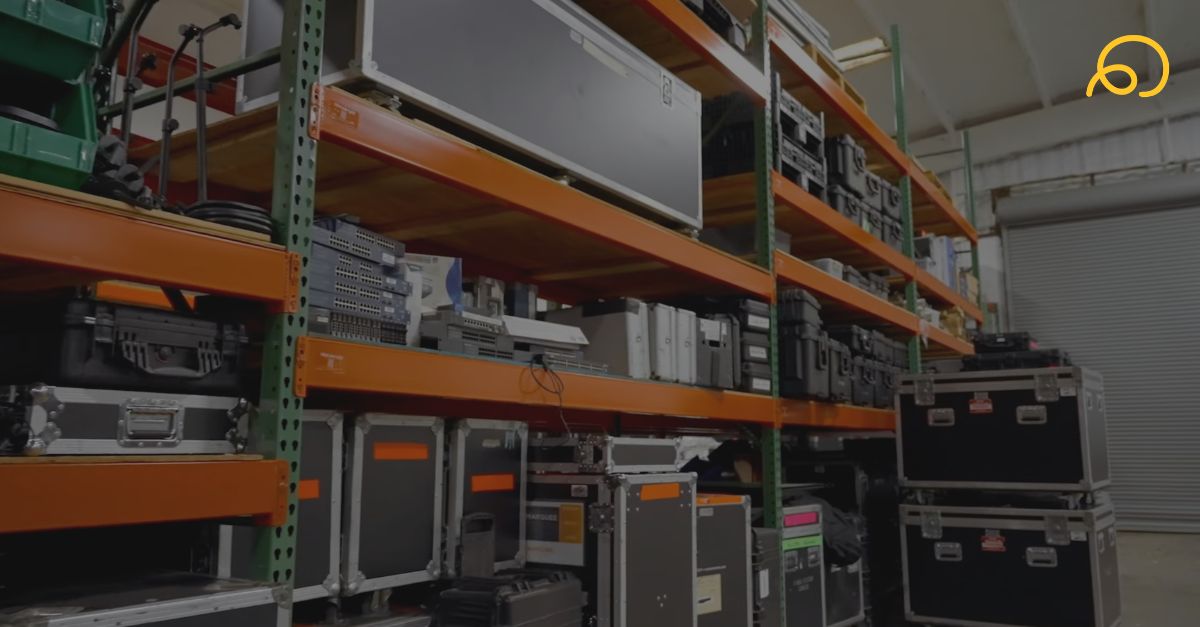
Before you budget for a rollout, it’s worth understanding what you’re actually dealing with in a working AV or production environment. RFID in warehouse settings comes with some well-documented challenges:
Signal interference. Metal shelving, racking, and equipment absorb or reflect radio waves, causing read failures or inconsistent scans. Liquids — including products with high water content — absorb RF signals too.
Tag placement. Where you put the tag matters enormously. Tags buried inside a stack of items or placed directly on metal surfaces won’t read reliably without specialized on-metal tags, which cost more.
Reader and tag collision. Multiple readers in close proximity can interfere with each other, creating phantom reads or missed scans. When many tagged items pass through a read zone simultaneously, the reader can struggle to process all the signals — leading to missed tags in high-density scenarios.
Environmental wear. Temperature extremes, humidity, and dust — common in production warehouses — degrade tag adhesive and affect read range over time.
Read range variability. Passive UHF RFID reads at 10–20 feet under ideal conditions. Real-world warehouse environments routinely cut that range significantly.
Cost and implementation. Tags, readers, antennas, and the middleware to tie it all together add up fast — especially retrofitting an existing facility.
Data accuracy vs. inventory reality. RFID tells you a tag was scanned in a location. It doesn’t tell you the item is actually there correctly. Misplaced or damaged goods can still cause discrepancies.
None of this means RFID isn’t worth pursuing eventually. It means it requires a serious operational foundation to deliver on its promise.
The Foundation Is Knowing Where Your Gear Is
The goal has always been confidence: knowing what you have, where it is, and whether it’s ready to go before loading out. That’s achievable right now, without a hardware investment, if your system is actually doing its job.
What that looks like in practice:
- Containers and kits built around how gear moves, so your team isn’t improvising at every pull
- Check-in/check-out workflows that create accountability — not workarounds
- Inventory counts your ops team would stake a quote on
- A system that holds the line on process instead of letting bad habits compound show after show
When those things are in place, your team moves faster, your counts get more accurate, and your financial visibility improves. No new hardware required.
Build the Foundation First
The companies that will get the most out of RFID are the ones who’ve done the harder work first: locking in their workflows, building accountability into daily operations, and getting to a place where they trust their data.
When your foundation is solid, adopting new technology is straightforward. When it’s not, you’re just adding cost to a problem that hasn’t been solved.
You don’t have to wait for RFID to run a tighter operation. Get the workflow right, know where your gear is, and everything else — including whatever technology comes next — gets easier from there.
Want to see what inventory accountability looks like in practice? Explore LASSO’s Inventory workflows in our Demo Center — no form, no sales call, just the product. Explore Inventory Demos →
Mel Baglio is an Industry Engineer at LASSO, where she works with event production companies to untangle operational complexity and build the systems that make show day less chaotic.