

AI Agents vs. AI Chatbots: The Short Answer
An AI chatbot answers questions. An AI agent does the work. A chatbot tells you how to build a crew roster for Thursday’s load-in. An agent builds the roster, checks availability, flags conflicts, and hands you something to approve. One is a smarter search box. The other is an extra set of hands.
That distinction matters more than any buzzword you’ll hear this year — especially if you’re running a live event company. Here’s what every operator should understand before evaluating an AI tool.
What Is an AI Chatbot?
An AI chatbot is a conversational interface that retrieves information and generates responses. You ask a question. It answers. You ask a follow-up. It answers again. That’s the whole loop.
Chatbots are useful for surfacing information fast — summarizing a document, drafting an email, explaining a concept, answering a support question. They work well when the output you need is words on a screen.
Where they fall short: they can’t take action on your behalf. A chatbot can describe how to update a quote in your event software. It can’t actually update the quote.
What Is an AI Agent?
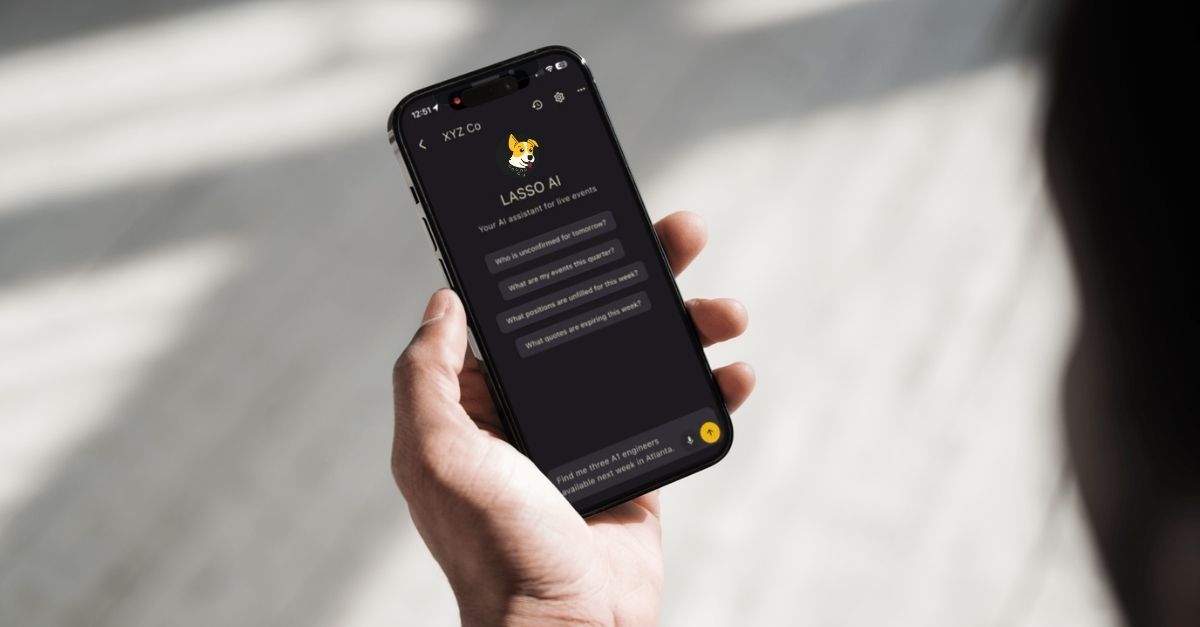
An AI agent is a system that takes multi-step action to complete a goal. It doesn’t just talk about the work — it does the work. Good agents can pull data from connected systems, make decisions based on context, execute a sequence of tasks, and return a completed output for human review.
In event operations, that looks like: “Build a crew schedule for the three events next week.” The agent pulls available crew from your database, cross-references certifications and rates, checks conflicts against existing assignments, drafts the schedule, and hands it back for approval. That’s one request, many steps, one result.
The distinction isn’t theoretical. It’s the difference between software that helps you think and software that helps you ship.
AI Agents vs. AI Chatbots: A Side-by-Side Comparison
| What It Does | AI Chatbot | AI Agent |
|---|---|---|
| Primary output | Text and answers | Completed tasks and actions |
| Steps per request | Single response | Multi-step execution |
| Connection to your systems | Usually none | Pulls and acts on live data |
| Best for | Quick questions, drafting, summaries | Operational work, workflow execution |
| Human role | Asks the question, applies the answer | Reviews and approves the work |
Why the Distinction Matters for Event Production
Live event production doesn’t run on conversations. It runs on execution. Quotes have to go out. Crew has to be confirmed. Gear has to be reconciled. Shifts have to be adjusted when the tour schedule changes at 4 PM on a Friday. The time operators lose isn’t in thinking through these tasks — it’s in doing them, over and over, across systems that don’t talk to each other.
A chatbot can help you think through a staffing plan. It can’t staff the show. For an industry where the cost of an unexecuted task is a missed show, that gap is the entire game.
When we talked to operators about where their weeks were going, the answers weren’t about creative work. They were about the connective tissue — building quotes, checking availability, reconciling data, cleaning up after closed events. One operator told us they spend 80+ hours a week just verifying data is accurate across their tools. That’s the kind of work an AI agent is built for. A chatbot can’t touch it.
What to Look for in an AI Agent Built for Your Industry
Not every AI agent is built the same — and most of them weren’t built for event operations at all. A few questions worth asking before you trust one with your work:
- Does it know your industry? Generic AI doesn’t understand what an A1 is, how a load-in works, or why a subrental call changes by the hour. Industry-native AI starts with the vocabulary, workflows, and data of the business you actually run.
- Does it ask before it acts? Good agents confirm decisions with a human before executing them. “Confirm with me” should be the default, not an option.
- Can it show its work? You should always be able to see why it did what it did — and correct the reasoning if it’s off.
- Is everything it does reversible? Nothing an AI agent does should be permanent without a person saying so.
- What happens to your data? Your customer lists, rate cards, and crew histories are the business. They shouldn’t be training fuel for someone else’s model.
The Bottom Line
Chatbots answer. Agents act. Both have their place — but if you’re running a production company, the work you need help with isn’t the talking. It’s the doing. The tools you evaluate from here on out should be measured by what they ship, not what they say.
We’re talking about this more on the next episode of Corralling the Chaos, where Angela Alea and Clay Sifford get into what this industry actually needs from AI — and what we’re building with it in mind. Listen here when it drops.