

If you run an event production company, you’ve been handed a new vocabulary almost overnight. Agents, models, LLMs, RAG, hallucinations — and that’s before the vendor pitch even starts.
Most AI glossaries are written for engineers. This one is written for operators. Each term is defined in plain English, then grounded in the work you actually do — load-ins, quotes, crew scheduling, payroll, the connective tissue of running a production company. Bookmark it. Send it to your team. Use it the next time a vendor opens a sentence with “our proprietary model.”
The AI Terms Every Event Operator Should Know
Agent (AI Agent)
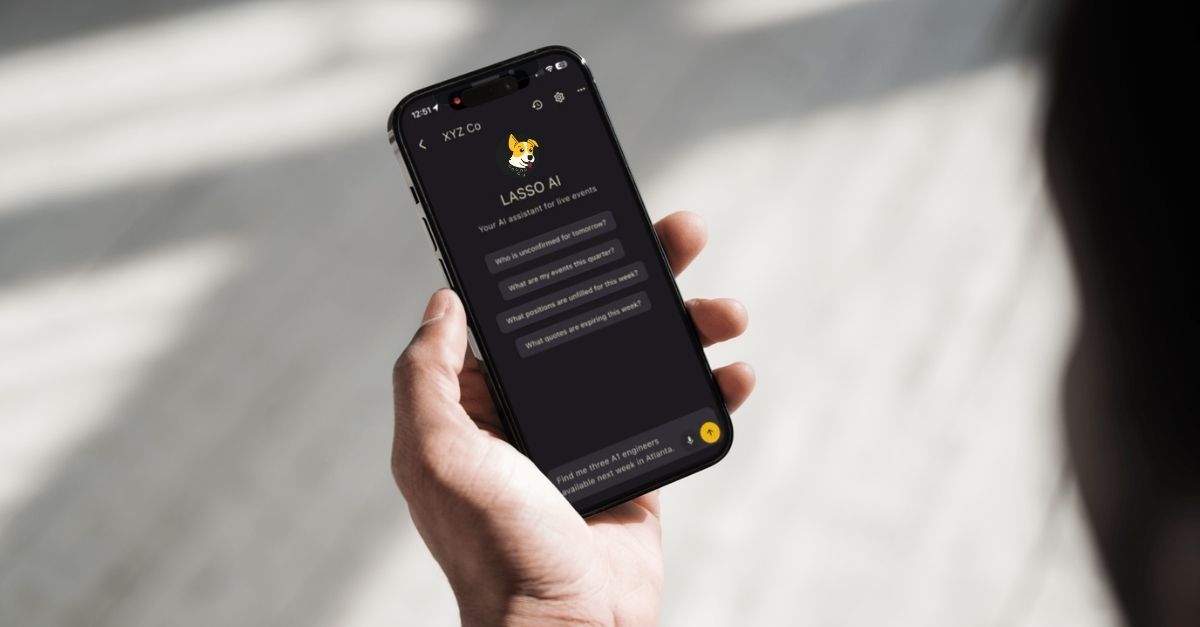
An AI system that takes multi-step action to complete a goal — not just answering questions, but doing the work. A good agent can pull data from your systems, make decisions based on context, execute a sequence of tasks, and return a completed output for human review. Example: “Build a crew schedule for next week’s three shows” — the agent pulls available crew, checks certifications, flags conflicts, and hands you a draft.
Agentic AI
AI designed to act, not just respond. Agentic systems take initiative inside defined boundaries — they can break a complex request into steps, use tools, and follow through. In event operations, this is the difference between an AI that tells you how to reconcile a timesheet and one that actually reconciles it.
AI (Artificial Intelligence)
A broad category of software that performs tasks typically requiring human intelligence — recognizing patterns, making decisions, generating language, solving problems. Most of what’s marketed as “AI” today is a specific flavor called machine learning, usually a large language model. In your operation, AI shows up as tools that can read your data, answer questions about it, or take action inside your workflow.
Chatbot (AI Chatbot)
A conversational interface that retrieves information and generates text. You ask, it answers. Useful for drafting, summarizing, and quick questions — but a chatbot doesn’t take action in your systems. A chatbot can describe how to update a quote. An agent can actually update the quote.
Fine-tuning
The process of training a general AI model on specialized data so it performs better on specific tasks. Fine-tuning is one way vendors try to make generic models feel industry-specific — but it’s not the same as building AI on top of real industry data and workflows. Ask vendors whether their AI was trained from the ground up on event operations data, or fine-tuned on top of a general-purpose model.
Generic AI
AI tools built to serve every industry and use case equally — ChatGPT, Copilot, generic assistants. They’re powerful for writing and summarizing, but they don’t know your business. They can’t see your crew, your gear, your rates, or your margins. Generic AI is a shared calculator; industry-native AI is built for how your business actually works.
Hallucination
When an AI confidently generates information that isn’t true. Hallucinations happen because most AI doesn’t “know” anything — it predicts likely responses based on patterns in training data. In low-stakes writing, a hallucination is embarrassing. In event operations, a confident wrong answer can cost a show. This is why human-in-the-loop and source transparency aren’t nice-to-haves — they’re the floor.
Human-in-the-Loop
A design principle where AI takes action only with human approval or oversight. In practice: the AI drafts, recommends, or prepares — the operator reviews, edits, and confirms. When customers told us what they’d need to trust an AI agent, nearly every response came back to this: “Confirm with me.” “Ask me first.” “Show me the reasoning.” That’s human-in-the-loop.
Industry-Native AI
AI built from the ground up on the vocabulary, workflows, and data of a specific industry. Not generic AI with an industry prompt layered on top. True industry-native AI knows the difference between a load-in and a strike, understands what an A1 does, and treats a subrental like a subrental. If the AI you’re evaluating can’t fluently use the language of your operation, it was built for someone else’s.
Inference
The moment an AI model actually generates a response. Training is how the model learns; inference is it doing the job. You’ll rarely use this word out loud, but if a vendor talks about “inference speed,” they mean how fast the AI produces an answer.
Large Language Model (LLM)
A type of AI trained on enormous amounts of text — books, articles, websites — to predict and generate human-like language. LLMs power most of the AI tools you’ve heard of, including ChatGPT and Claude. An LLM is the engine. Whether that engine is useful for your business depends on what’s connected to it.
Machine Learning (ML)
A branch of AI where systems learn patterns from data instead of being explicitly programmed. Most modern AI is machine learning. When a vendor says “our AI learns your business,” they mean machine learning — just make sure you understand what data it’s learning from and where that data goes.
MCP (Model Context Protocol)
An open standard that lets AI models securely connect to external systems and take action inside them. MCP is why modern AI agents can read your data and execute tasks across tools instead of being stuck in a chat window. If your AI can’t connect to the systems where your work actually lives, it can’t help you do the work.
Model
The underlying AI system doing the thinking — the trained engine that takes your input and produces an output. When people say “GPT-4” or “Claude,” they’re naming specific models. The model matters less than what it’s connected to and how it’s applied to your business.
Prompt
The instruction you give an AI. A good prompt is clear, specific, and includes context — “build a crew schedule for the three shows next week using my existing certifications and rate cards” is a prompt. “Help me with scheduling” is a wish. In agentic systems, prompts are often written for you by the product, so you’re not managing the phrasing — you’re directing the work.
RAG (Retrieval-Augmented Generation)
A technique where AI pulls information from a trusted source — like your company’s data — before generating an answer, instead of relying only on what it learned during training. RAG is how AI stays grounded in your actual business data. RAG is the difference between an AI that answers from its general knowledge and one that answers from your rate card.
Training Data
The information an AI model was taught on. The quality, relevance, and recency of training data shape what the AI can do — and what it’s blind to. Ask vendors what their AI was trained on. If the answer is vague, assume it doesn’t know your industry.
Vertical AI
AI designed for a specific industry, as opposed to horizontal (general-purpose) AI. Vertical AI for event production would be purpose-built for crew, gear, scheduling, payroll, and compliance in live events — not a generic tool adapted to the work. Industry-native AI is vertical AI done right.
What to Do With This Vocabulary
Terms don’t make decisions — operators do. But knowing the vocabulary means you can press vendors on claims, ask sharper questions, and separate AI that’s built for your industry from AI that’s been pointed at it.
Two follow-ups worth reading next: our piece on the difference between AI agents and AI chatbots, and our take on build vs. buy AI for event production companies.